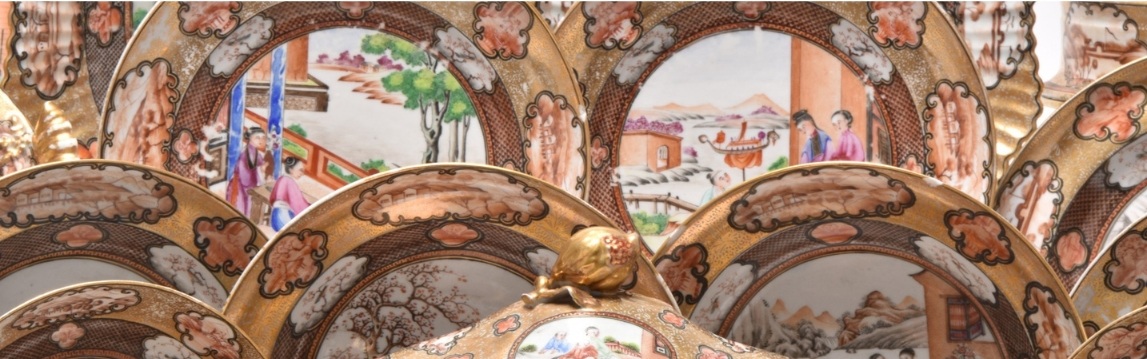
Among the most captivating achievements of Chinese export porcelain is the so-called Rockefeller pattern, a richly decorated style that combines exceptional craftsmanship, vibrant enamel decoration, and fascinating collecting history.
12/06/2026
Going under the hammer next week at Halls | The Auction House is an 18th-century part dinner service in this celebrated pattern not only exemplifies the finest traditions of Chinese porcelain production but also carries a distinguished family provenance stretching back more than two centuries.
The service comprises 39 pieces, including a fruit cooler liner and cover, fluted square dishes, a sauce tureen and cover, reticulated chestnut baskets, teabowls, coffee cans, saucers, and circular dishes. Each piece is decorated in brilliant famille rose enamels and features a unique, finely painted figural scene set within gardens, landscapes, terraces, or domestic settings.
What immediately distinguishes the Rockefeller pattern is its extraordinary decorative complexity. The central scenes are framed by intricate sepia diaper borders and lavish gilt scrollwork, punctuated by cartouches painted in sepia and iron-red. No two scenes are exactly alike, creating a sense of narrative richness across the service while showcasing the skill of the individual artists who painted each piece..jpg)
The Rockefeller pattern emerged during the late Qianlong and early Jiaqing periods, approximately between 1790 and 1810. These wares were created specifically for the Western export market at a time when wealthy European and American patrons commissioned elaborate dinner services through the flourishing China trade.
Originally known among collectors as "Palace Ware", the name reflected the opulent appearance of the porcelain rather than any documented connection to the Chinese Imperial Court. The combination of luxurious gilding, detailed figure painting, landscape reserves, and decorative borders made these services among the most expensive and admired export porcelains of their era.
The later designation, "Rockefeller pattern," emerged during the twentieth century after significant examples entered the collections of members of the Rockefeller family, including John D. Rockefeller Jr., Nelson Rockefeller, and David Rockefeller. Their enthusiasm for Chinese export porcelain helped elevate the pattern's profile among collectors and scholars, transforming it into a recognised collecting category in its own right.
.jpg)
Beyond its artistic significance, this particular service boasts an exceptional provenance.
The pieces descended directly from the collection of Major John Bridge (1777–1837). Bridge served with the 45th Regiment and later with the 63rd Regiment during the Peninsular War under the Duke of Wellington, ultimately attaining the rank of Sergeant Major. Following the conclusion of the conflict, he returned to Dublin, where he became Master of the Barracks, a position he held until his death in 1837.
The porcelain service remained within the family for generations, passing from Bridge to his descendants and eventually to the vendor, his paternal great-great-great-grandson. Such continuous family ownership adds a compelling human dimension to the collection and provides a rare, documented link between the object and its historical owners.
The enduring appeal of Rockefeller pattern porcelain lies in its remarkable balance of technical mastery and visual drama. The painstakingly painted central scenes demonstrate the skill of Chinese artists working to satisfy the tastes of affluent Western clients, while the gilded borders and decorative cartouches create an unmistakable sense of grandeur.
Many scholars believe that some of the largest Rockefeller-pattern services were commissioned by prominent British trading families associated with the East India Company. One particularly important service is thought to have been ordered around 1805 by John Roberts, a Director of the British East India Company, illustrating the close relationship between global trade, luxury consumption, and artistic production during this period.
Today, these wares are admired not only as beautiful examples of Chinese export porcelain but also as tangible reminders of the international networks that connected China, Britain, Europe, and America at the dawn of the nineteenth century.
.jpg)
With an auction estimate of £5,000–£8,000, this rare Rockefeller pattern part dinner service represents a remarkable opportunity to acquire a surviving example of one of the most celebrated decorative schemes in Chinese export porcelain.
Combining artistic excellence, historical significance, and an unbroken family provenance, the service stands as a testament to the sophistication of late eighteenth-century Chinese craftsmanship and the enduring fascination of the China trade. More than two centuries after it was created, its richly painted scenes and brilliant gilding continue to captivate collectors and historians alike.
 +44 (0)1743 450 700
 [email protected]
.